Her app helps couples grow closer
A life-threatening diagnosis prompted Khadesha Okwudili ’16 to think about what makes personal connections strong.
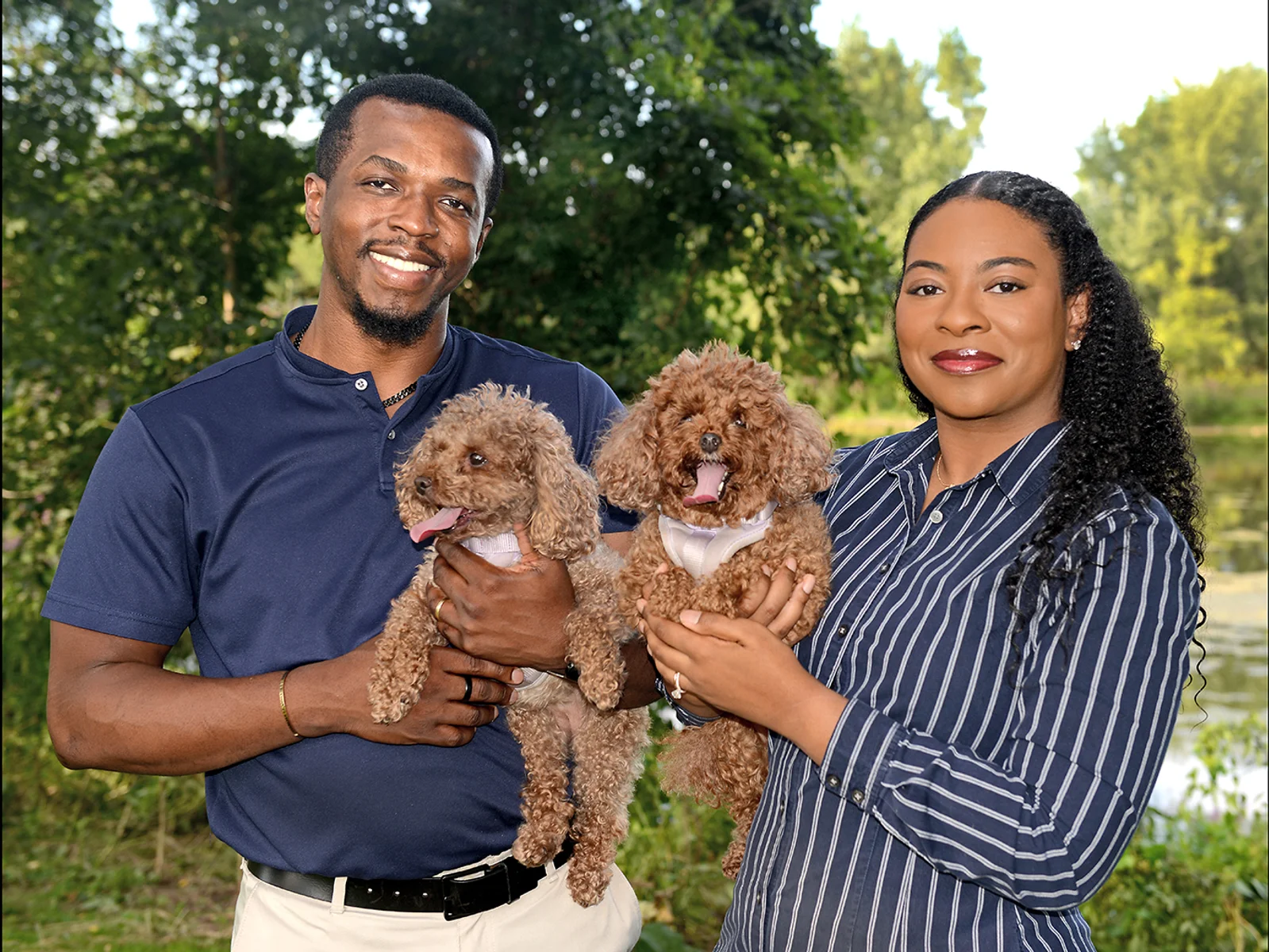
In fourth grade, Khadesha Okwudili wanted to be a doctor. By the time she started at FLCC in January 2015, she aspired to be an M.D.-Ph.D., a physician-scientist, treating patients and conducting research.
Then, while on the elliptical in the exercise room at the Suites at Laker Landing residence hall, she passed out. For the next several years, her life became both frightening and exciting: a life threatening diagnosis, experimental surgery, and personal revelations that led to a widely used relationship app called Agapé.
Taking stock
Heart palpitations that started in Khadesha’s early teens turned out to be catecholaminergic polymorphic ventricular tachycardia (CPVT), a rare heart rhythm disorder. Stress and exertion can cause arrhythmias that lead to fainting or cardiac arrest.
“I wasn't responding well to treatment. I didn’t know how things were going to go. It compelled me to start asking questions,” she said. Khadesha began having weighty conversations with friends and family about their life goals and what made them feel valued.
“Although my health was declining, my relationships started thriving in a way they never had before.” Experimental surgery at the Mayo Clinic in Rochester, Minn., stabilized her condition and gave her time to reflect on topics she had explored amid the tumult of her treatment.
“I became a deep conversation evangelist. I could meet someone at the store and have a super deep conversation,” she said. “Because of my research background, I wanted to see whether this was just my experience and whether there was research around deep conversations.”
Going viral
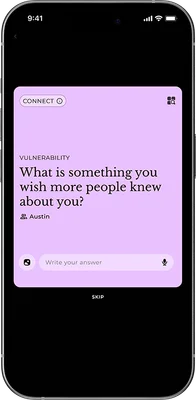 A sample question from the Agapé app.
She found a 2013 study led by Ron Rogge, associate professor at the University of Rochester, in the Journal of Consulting and Clinical Psychology. He compared the three-year divorce rates of three groups of couples. Two groups attended marriage counseling programs led by professionals. He had the third group watch movies about relationships together and have a discussion guided by a series of questions. He found the “watch and talk” option just as effective as more intensive therapy.
Khadesha had studied at the University of Rochester, so she reached out to Ron with an idea: “What if we created an app that could ask questions to spark meaningful conversations? Could it be as impactful for others as it had been for me?” Ron jumped at the opportunity, finding it to be both an interesting research question and a way to reach more people than research typically does.
“We started working on building the app together, and after a year, the app was launched,” she explained. The app’s name, Agapé, is ancient Greek for unconditional love.
“We didn’t really know how to do any marketing. At first, we had a few hundred users, and then in February 2021, a user created a TikTok about Agapé, and we got over 100,000 installs overnight. That set the trajectory for growth. It’s that viral video everyone always hopes will happen.”
Equilibrium
Today Agapé has about 4 million registered users. There is a basic version and a paid version. Khadesha is founder and chief executive officer. Ron is the chief research officer and vets all the questions. They work with a three-person engineering team.
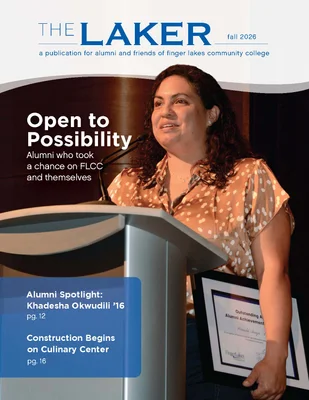 Khadesha's story is featured in the fall 2026 Laker Magazine.
Khadesha, Ron and a collaborator, Jenna A. Macri, published a study in the Journal of Family Psychology in 2024 in which they surveyed 405 couples in their first month of using the app. Eighty percent reported improved relationships and 70 percent said their personal well-being had improved.
“I’ve talked to a lot of our users — like thousands — because I used to do the customer support, and they’ve said really incredible things. We have a lot of couples in long-distance relationships who use Agapé. We have a lot of military couples who reach out and say how much it helps them when their partner is deployed.”
The team has even been invited to weddings, though Khadesha has not attended any. One user wrote a song based on the questions he and his partner answered.
“I’m still working on the app,” Khadesha said. “I am considering other things, maybe starting a second app. I feel like I learned what I would want to learn from it, and it’s benefiting people. I feel like it’s at a good equilibrium.”
Back at FLCC
Another project Khadesha recently tackled: finally taking anatomy and physiology at FLCC. She enrolled in the course with Assistant Professor Amy Fenwick, in part out of her fondness for the College. (She got an A.)
“FLCC, for me, was the first time I was in school where it felt like my teachers really, really cared,” she said, calling out her calculus instructor, retired Professor Ronald Metzger. “I’ve taken classes at FLCC. I’ve taken classes at the University of Rochester, and I’ve also taken classes at the University of Pennsylvania,” she said. “If someone asks me who my best teachers were, most of them were at FLCC. That influenced my requirements when hiring engineers.
“I don’t judge people by their pedigree. The best engineer I worked with, for example, only has a GED. FLCC was a good reminder that something doesn’t have to be perceived to be prestigious to still be exceptional.”